MLOps: Vận Hành Mô Hình Machine Learning Trong Production
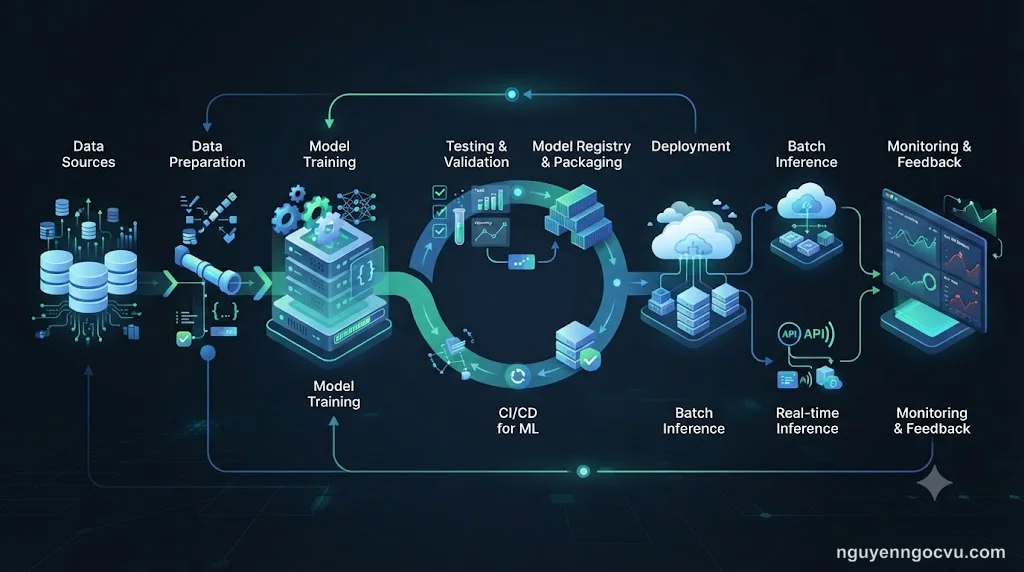
MLOps (Machine Learning Operations) là quy trình DevOps áp dụng cho machine learning — tự động hóa triển khai, monitoring và vận hành mô hình ML trong production. MLOps giải quyết ba vấn đề lớn: mô hình ML khó tái tạo (dữ liệu + code + config), xuống cấp âm thầm theo thời gian (drift), và yêu cầu retrain liên tục. Một pipeline MLOps đầy đủ bao gồm data versioning, automated training, model registry, CI/CD deployment, monitoring drift và continuous training.
MLOps là gì và tại sao cần thiết?
MLOps là giao điểm giữa Machine Learning, DevOps và Data Engineering. Nó áp dụng các nguyên tắc DevOps — version control, CI/CD, automated testing, monitoring — vào vòng đời mô hình ML.
Tại sao cần MLOps?
Thực tế ngành: 87% mô hình ML không bao giờ đến production (Gartner 2022). Nguyên nhân? Không trace được dataset + code + hyperparameters version nào tạo ra mô hình đó. Reproducibility crisis.
Rồi còn vấn đề model decay. Khác phần mềm truyền thống (logic không đổi), mô hình ML xuống cấp theo thời gian vì dữ liệu thực tế thay đổi. Một mô hình dự đoán giá nhà train trên dữ liệu 2020 có thể fail hoàn toàn năm 2026 do thị trường thay đổi. Concept drift.
Và manual deployment hell: mỗi lần deploy mất 2-4 tuần — export model, viết API wrapper, containerize, test, deploy, rollback khi lỗi. MLOps giảm còn 1-2 giờ với pipeline tự động.
Case study thực tế: Uber xây MLOps platform Michelangelo để quản lý 1,000+ mô hình ML — surge pricing, ETA, fraud detection.
Trước Michelangelo? Mỗi team tự deploy, không chuẩn, incident thường xuyên.
Sau khi triển khai: thời gian deploy giảm từ 3 tuần xuống 2 giờ. Model monitoring tự động. Retrain hàng ngày.
Các thành phần cốt lõi của MLOps pipeline
1. Data Management & Versioning
Vấn đề: Code versioning (Git) không đủ — dữ liệu train/test cũng cần version để tái tạo mô hình.
Giải pháp:
- DVC (Data Version Control): track dataset bằng Git-like commands (
dvc add,dvc push). Metadata lưu Git, file thật lưu S3/GCS. - LakeFS: Git cho data lake — branch/merge/rollback trên dataset lớn.
- Feature Store (Feast, Tecton): lưu features đã transform, tránh train-serving skew (offline vs online features khác nhau).
Ví dụ workflow:
# Data scientist
dvc add data/train.csv
git add data/train.csv.dvc .dvc/config
git commit -m "data: add Sept 2026 training set"
git tag data-v1.2
dvc push

# Teammate reproduce
git checkout data-v1.2
dvc pull  # → lấy đúng data version tương ứng
2. Experiment Tracking & Model Registry
Vấn đề: Chạy 100 experiments với các hyperparameters khác nhau — làm sao nhớ config nào cho kết quả tốt nhất?
Giải pháp:
- MLflow Tracking: log parameters, metrics, artifacts (model file) mỗi lần train.
- Weights & Biases: tracking + visualization + collaboration (compare runs).
- Model Registry (MLflow Registry, Vertex AI Model Registry): catalog các mô hình đã train, gắn metadata (accuracy, training date, dataset version), quản lý lifecycle (staging → production → archived).
Ví dụ:
import mlflow

with mlflow.start_run():
    mlflow.log_param("learning_rate", 0.01)
    mlflow.log_param("n_estimators", 100)
    # ... train model ...
    mlflow.log_metric("accuracy", 0.94)
    mlflow.sklearn.log_model(model, "model")
    # → tự động save vào registry với run ID
Registry giúp rollback nhanh: mô hình mới có bug → promote lại version cũ lên production trong 5 phút.
3. Continuous Training Pipeline
Vấn đề: Dữ liệu mới đến hàng ngày — làm sao retrain tự động và deploy khi performance tốt hơn?
Giải pháp: Orchestration tools (Airflow, Prefect, Kubeflow Pipelines) schedule DAG:
[Fetch new data] → [Validate] → [Preprocess] → [Train] → [Evaluate]
→ [if accuracy > current_prod + 2%] → [Register to staging] → [A/B test]
→ [Promote to prod]
Best practices:
- Retrain frequency: phụ thuộc drift rate. E-commerce (drift nhanh) → hàng ngày; credit scoring (chậm) → hàng tháng.
- Gating logic: chỉ deploy nếu (a) metrics tốt hơn threshold VÀ (b) pass integration tests VÀ (c) không có data quality alert.
- Shadow mode: chạy mô hình mới song song với prod, log predictions nhưng không serve user → so sánh performance trước khi promote.
4. Model Serving & Deployment
Vấn đề: Làm sao serve mô hình với low latency, high availability và dễ scale?
Patterns phổ biến:
a) REST API deployment (phổ biến nhất):
- Wrap model trong Flask/FastAPI container
- Deploy lên Kubernetes với autoscaling
- Load balancer phía trước
- Ưu: đơn giản, language-agnostic client
- Nhược: latency ~50-200ms (network + serialization)
b) Batch inference:
- Chạy predictions theo batch (mỗi giờ/ngày) và cache kết quả
- Ưu: throughput cao, cost thấp
- Nhược: không realtime
- Use case: recommendation precompute, fraud scoring overnight
c) Streaming inference:
- Kafka Streams / Flink process events realtime
- Use case: fraud detection, ad bidding
d) Edge deployment:
- TensorFlow Lite / ONNX Runtime trên mobile/IoT
- Use case: offline inference, privacy-sensitive apps
Deployment strategies:
- Blue-Green: deploy version mới (green), test, rồi chuyển traffic từ blue sang green một lần.
- Canary: route 5% traffic vào mô hình mới, monitor, tăng dần lên 100%.
- A/B test: split traffic 50/50 giữa hai mô hình, measure business metrics (conversion, revenue) chứ không chỉ accuracy.
5. Monitoring & Alerting
Vấn đề: Mô hình fail thầm lặng.
Accuracy drop 20% nhưng không ai biết đến khi user complain. Đó là lúc đã muộn.
Metrics cần monitor:
a) Model performance metrics:
- Accuracy, precision, recall theo thời gian (rolling window 24h/7d)
- Alert nếu drop >5% so với baseline
b) Data drift:
- Population Stability Index (PSI): measure phân phối feature thay đổi bao nhiêu
- KL divergence: compare train distribution vs production distribution
- Alert khi PSI >0.2 hoặc KL >threshold
c) Prediction drift:
- Phân phối predictions thay đổi (vd model bỗng predict 90% class A thay vì 50%)
d) Operational metrics:
- Latency (p50, p95, p99)
- Throughput (requests/sec)
- Error rate
- Resource usage (CPU, memory, GPU)
Tools: Prometheus + Grafana (metrics), Evidently AI / Arize (ML-specific monitoring), PagerDuty (alerting).
Ví dụ alert rule:
alert: ModelAccuracyDrop
expr: accuracy_7d < 0.85 AND accuracy_7d < accuracy_baseline * 0.95
for: 2h
annotations:
  summary: "Model accuracy dropped to {{ $value }}"
6. CI/CD for ML
Vấn đề: Code tests không đủ — cần test mô hình (data quality, model bias, performance regression).
ML-specific tests:
- Data validation: schema check (Great Expectations), outlier detection
- Model tests:
- Unit test inference code
- Performance test (accuracy ≥ threshold trên hold-out set)
- Bias/fairness test (demographic parity, equal opportunity)
- Invariance test (prediction không đổi khi flip irrelevant features)
- Integration test: end-to-end inference với sample data
CI/CD pipeline example:
Code push → [Run unit tests] → [Trigger training on CI]
→ [Validate model performance] → [Build Docker image]
→ [Deploy to staging] → [Run integration tests]
→ [Manual approval] → [Deploy to prod]
Tools: GitHub Actions / GitLab CI + custom ML test scripts.
MLOps Maturity Levels
Google định nghĩa 3 levels (theo paper “MLOps: Continuous delivery and automation pipelines in ML”):
Level 0: Manual process
- Train model trong notebook
- Deploy thủ công
- Không CI/CD, không monitoring
- Phù hợp: POC, research
Level 1: ML pipeline automation
- Automated training pipeline
- Model registry
- Continuous training
- Vẫn thiếu: CI/CD cho pipeline code, automated deployment
Level 2: CI/CD automation
- Pipeline code versioned & tested
- Automated deployment
- Monitoring drift & auto-retrain
- Production-grade MLOps
Lời khuyên từ thực tế: Team mới? Bắt đầu từ Level 0 để iterate nhanh.
Scale lên Level 1 khi có ≥2 mô hình production. Đạt Level 2 khi team ML >5 người hoặc mô hình business-critical — nghĩa là nếu nó fail thì công ty mất tiền.
Tools & Platforms Comparison
| Category | Open Source | Managed Platform |
|---|---|---|
| Experiment Tracking | MLflow, Weights&Biases (freemium) | Azure ML, Vertex AI |
| Orchestration | Airflow, Prefect, Kubeflow | AWS Step Functions, Vertex Pipelines |
| Model Serving | BentoML, KServe, Seldon Core | SageMaker, Vertex AI Endpoints |
| Monitoring | Evidently AI, Alibi Detect | AWS Model Monitor, Datadog ML |
| Feature Store | Feast | Tecton, SageMaker Feature Store |
| All-in-one | - | Databricks ML, Vertex AI, SageMaker |
Khi nào chọn open source?
- Team có DevOps/infra expertise
- Multi-cloud hoặc on-prem requirement
- Cost-sensitive (managed platforms đắt 2-5x)
Khi nào chọn managed platform?
- Team nhỏ, không có dedicated ML engineer
- Cần scale nhanh
- Tích hợp sâu với cloud ecosystem (BigQuery, S3, etc.)
Best Practices từ thực tế
-
Start simple, scale gradually: Level 0 → 1 → 2. Đừng over-engineer khi chỉ có 1 mô hình.
-
Treat data as code: version everything — code, data, config, environment (Docker).
-
Automate testing: mỗi model update phải pass ≥3 tests (data quality, performance, bias).
-
Monitor business metrics, không chỉ model metrics: accuracy 95% vô dụng nếu conversion rate giảm.
-
Plan for rollback: mỗi deployment cần rollback plan 1-click. Lưu ≥3 model versions gần nhất.
-
Document everything: mỗi mô hình cần model card (use case, training data, known limitations, fairness considerations).
-
Collaborate cross-function: MLOps thành công khi data scientist, ML engineer và DevOps làm việc cùng nhau — không phải handoff qua tường.
Thách thức phổ biến và cách giải quyết
1. “Model works on my laptop but fails in prod” → Nguyên nhân: train-serving skew (preprocessing khác nhau), dependency mismatch → Fix: containerize toàn bộ pipeline (Docker), dùng feature store cho consistent preprocessing
2. “Không biết mô hình nào đang chạy production” → Fix: model registry + tag version, deployment manifest ghi rõ model_id
3. “Retrain quá lâu, block cả pipeline” → Fix: parallel training (Spark MLlib, Dask), incremental learning (update thay vì retrain from scratch)
4. “Alert noise — quá nhiều false positive” → Fix: tune threshold dựa trên business impact, alert fatigue → chỉ alert critical metrics
5. “Team data scientist không muốn dùng MLOps tools” → Fix: bắt đầu từ tools ít invasive (MLflow tracking = 3 dòng code), demo business value (deploy nhanh hơn 10x), training & documentation
Khi nào KHÔNG cần MLOps?
Thẳng thắn: không phải lúc nào cũng cần MLOps đầy đủ.
Skip MLOps nếu:
- Chỉ có 1 mô hình, không cần retrain thường xuyên (vd rule-based system chủ yếu)
- POC / research project, chưa production
- Team <3 người, model không business-critical
Tuy nhiên, ngay cả POC cũng nên có MLOps lite: version data + code (Git + DVC), log experiments (MLflow local), document assumptions. Tránh technical debt tích lũy.
Đọc thêm:
- RAG - Retrieval-Augmented Generation: Kỹ Thuật Nền Tảng AI Chatbot — RAG production cũng cần MLOps: monitor retrieval quality, retrain embedding model khi corpus thay đổi
- Agent AI Tự Động: Thiết Kế Và Triển Khai Thực Tế — triển khai agent AI trong production yêu cầu MLOps practices: version prompt templates, monitor failure modes, A/B test agent behaviors
- Prompt Engineering Nâng Cao: Kỹ Thuật Tối Ưu Giao Tiếp Với AI — prompt versioning và performance tracking là một phần của MLOps cho LLM applications
Câu hỏi thường gặp
MLOps khác gì DevOps truyền thống?
MLOps mở rộng DevOps với các thành phần đặc thù cho ML: data versioning, model registry, feature store, drift detection và continuous training. Khác với phần mềm truyền thống, mô hình ML phụ thuộc vào dữ liệu và có thể xuống cấp theo thời gian.
Khi nào cần triển khai MLOps?
Khi bạn có ≥2 mô hình ML chạy production, hoặc một mô hình cần retrain thường xuyên, hoặc team ML >3 người. Những dấu hiệu khác: mô hình fail thầm lặng, không trace được version, hoặc mất >1 tuần để deploy một update.
Tools nào cần thiết cho MLOps?
Stack tối thiểu: Git (code) + DVC/LakeFS (data), MLflow/Weights&Biases (experiment tracking + model registry), Docker/Kubernetes (deployment), Prometheus/Grafana (monitoring), Airflow/Prefect (orchestration). Nền tảng all-in-one như Vertex AI, SageMaker hoặc Databricks cũng đủ cho team nhỏ.
Làm sao phát hiện model drift?
Monitor hai loại drift: (1) Data drift - phân phối input thay đổi (dùng KL divergence, PSI), (2) Concept drift - quan hệ input-output thay đổi (track performance metrics theo thời gian). Alert khi metrics giảm >5% hoặc phân phối lệch >threshold. Retrain khi drift kéo dài >2 tuần.